
MCP requires an active MCP subscription on your account. A request from an account without one returns
403 Forbidden.Connecting
MCP servers are hosted on their own domain, notapi.affiliate.com:
Use
/all unless your client benefits from a narrower toolset — for example, to keep an agent’s available tools focused on one domain.
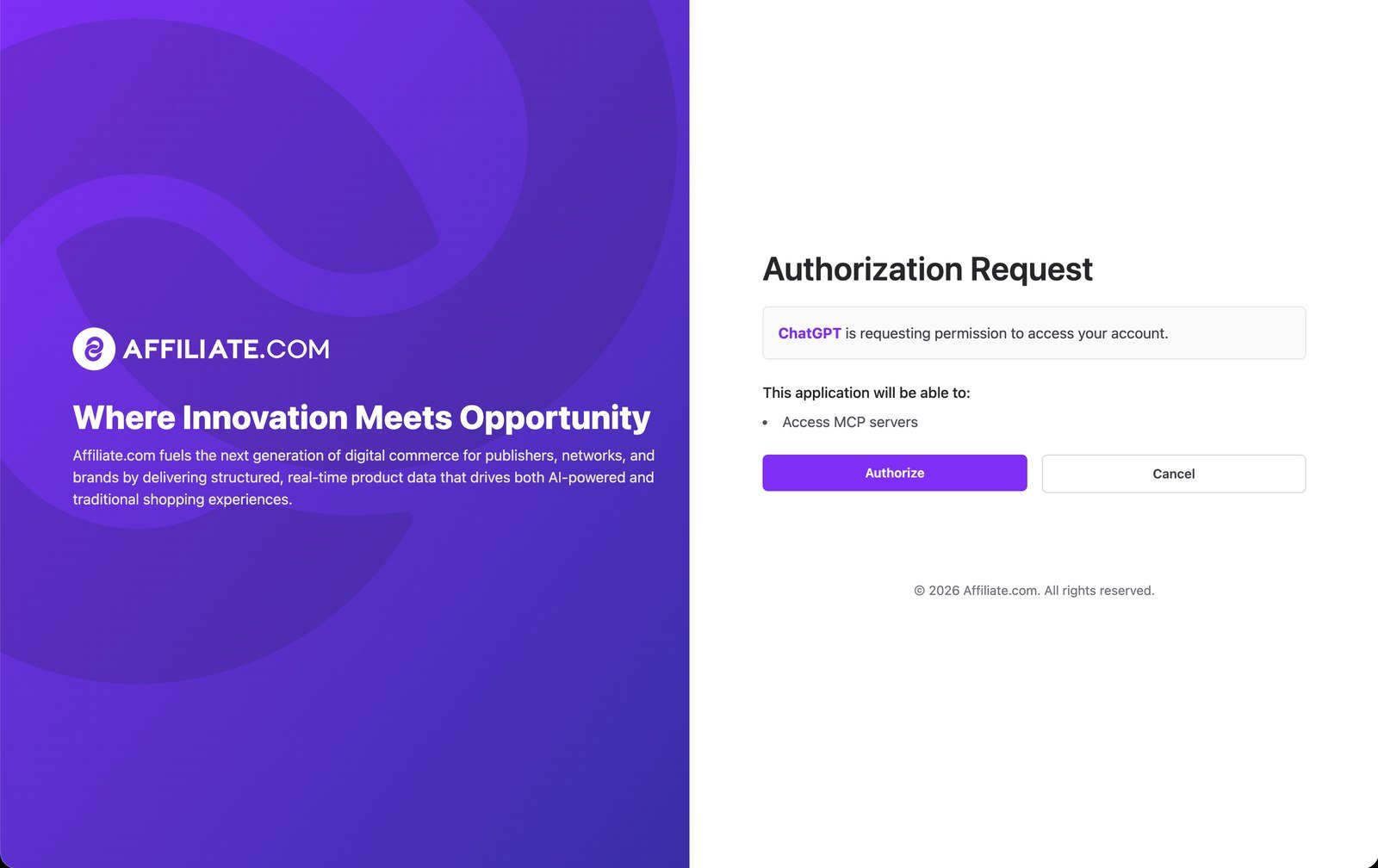
The consent screen your MCP client shows on first connection.
- ChatGPT
- Claude
- Claude Code / CLI
1
Enable Developer mode
Go to Settings → Apps → Advanced Settings and enable Developer mode.
2
Create the app
Click Create App:
- Name:
Affiliate.com(or any name you prefer) - MCP Server:
https://mcp.affiliate.com/all - Check “I understand and want to continue”
- Click Create
3
Use it in a chat
In the chat box, click + → More… → Affiliate.com.
A ChatGPT Plus or Pro account is required to use this feature.
Example prompts
Once connected, ask your AI client things like:- “Find 50 merchants with 20,000+ products that have logos. Show me their network info and their logo image URLs.”
- “What are the barcodes for these ASINs? B08DH979F7 and B09LNWG826”
- “Find laptops between $500–$700 USD, sorted by price. Give me also their PDP URLs.”
- “I’m looking for a comfortable office chair for back pain, my budget is $400, and I prefer buying it from Walmart.”
- “Find 10 Sony or Samsung headphones under $100 USD that are on sale now. Avoid duplicates. I need their product info, merchant and network info, and PDP URLs.”
- “Compare Nike vs Adidas running shoes — get merchant and price stats.”
Rate limits and usage
The same per-account rate limits that apply to the REST API apply to MCP requests. Each tool call also consumes account credits, at a weight that reflects the work it does:Tools
search-products
/product, /all
Search and filter products — the same field/value/operator search used by POST /v1/products, with a reduced operator set and feature list tuned for AI clients.
Natural-language query rewriting, semantic search, and image-based search are not available on this tool.
list-merchants
/merchant, /all
List merchants with filtering, search, and pagination.
- Standard mode (default): filter by network IDs, presence of icon/logo/description/domains, and product count range.
- Extended mode (
extended: true): adds category (id or name), canonical hierarchy, country (origin/market/generic), currency, feed language, approval status (relationship_status), approval scoped to a network credential (credential_id), promotion count range, pluscountry_ids/origin_ids/shopnomix_campaign_ids. In extended mode,network_idsaccepts prefixed IDs (rnet_for regional networks,net_for canonical networks). searchmatches merchant name or domain.- Pagination: page-based, maximum 100 per page.
get-merchant
/merchant, /all
Get full details for one merchant by id. Pass include_deleted: true to also retrieve archived (soft-deleted) merchants.
list-networks
/network, /all
List networks with filtering, search, and pagination — filter by group_ids, country_ids, or record_type (products or coupons); search by network name; sort by name, merchant count (total or active), product count, or country. Pagination: page-based, maximum 100 per page.
get-network
/network, /all
Get full details for one network by id, including its country and network group.
Conversion tools
/conversion, /all
Five tools convert between product identifier types:
barcode-to-sku and sku-to-barcode need a merchant, identified by either merchant_name (e.g. "walmart") or merchant_url (any URL on the merchant’s domain).
Response shape
Every tool returns the same top-level structure:null or an empty array in data, not an error.
Best practices
- Be specific. More specific queries return better results — “wireless over-ear headphones under $100 from Sony or Bose” beats “headphones.” Include brand, price range, or category when you know them.
- Use facets to explore. Before drilling into a large result set, ask for facets to see its shape: “Search for ‘running shoes’ with merchant and price facets.”
- Paginate by page number. Ask for a specific page — “Get page 2 of the laptop search results” — every list and search tool paginates this way.
- Chain tools for multi-step tasks. For example: search for products by keyword, pull barcodes for the ones you like, then convert those barcodes to ASINs to check Amazon availability. The
find-products-by-merchantandfind-products-by-regionprompts below already encode the most common chains.
Prompts
Beyond tools, the/product, /merchant, /network, and /all servers also expose MCP prompts — pre-built templates for common multi-step tasks that an MCP client can invoke directly: